With Oshi no Ko Vol. 3 coming out, I figured I’d make an initial post with my first drafts of some of the decks I want to make or upgrade with this set. Right now, I’m looking at a minor update of an existing deck, a complete rework of an existing deck, and a pretty much brand new deck (though with echos of an existing deck, I suppose). I haven’t tested any of these decks yet, so there’s a decent chance that they’ll need a number of changes, but I wanted to at least throw them out there as some potential starting points.
As always, you can find translations for the cards from the latest set on Weiss Tea Time (possibly moved to the archive).
Table of Contents
Kana/Akane
The main Oshi no Ko deck I played with set 2 is, unsurprisingly, the Kana Door / Akane Pants build (which I wrote about in a previous post). I’ve made some small updates since then; this is my current set 2 list:

Deck Log: ZTW3
This deck has a core of cards that are basically fixed, so naturally this is the one that’s just getting a few minor updates. The nature of this deck means that I’m pretty much only interested in level 0, 2, or 3 characters (with the level 0 characters having a significantly higher bar); events and level 1 characters are neither hits for the combo’s deck manipulation effect, nor playables at level 0, so I don’t want to include them if I can help it.
Let’s take a look at some possible additions.
Level 0s:
- Akane zero-two:

This will likely replace the Kana coinflip I’m running currently.
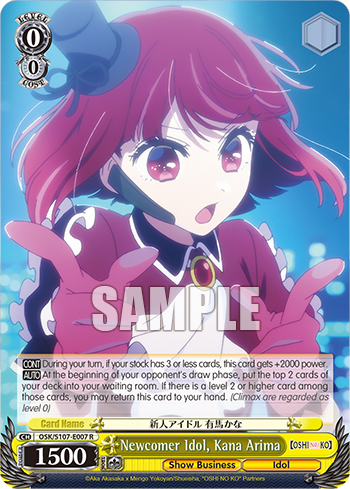
Both swing at 3.5k normally, but the Akane is more ok with tying. Both open a lane for a plus that’s likely but not guaranteed, though the Kana only opens the lane when it succeeds, while the Akane does so regardless; Akane is more likely to hit than Kana, 83.3% vs 70.2% for this deck. Neither of the plusses are selective, though the Kana looping itself can be nice when you’re stuck at level 0. Both of them can be supported by the level 1 combo, but can potentially mess up the deck manipulation at the same time. The Akane is better in that respect on account of being optional; if you don’t want to mill an extra card, you don’t have to. The Akane is also in a better color for the deck, and benefits more from the brainstorm’s coinflip ability (though it doesn’t have the neat interaction that Kana does with double brainstorm, where you can have the second one wait until after the mill if the first one whiffs).


On the other hand, the Kana works going first (or generally if you only attack once), while the Akane doesn’t. Overall, though, I’m still leaning towards the Akane, and perhaps the biggest reason for that is the top check, which makes it a nice card to play down later in the game, particularly alongside the level 1 combo, reducing the chance of losing climaxes in the initial check 4 or helping you decide whether to start with the combo or not if you don’t have triple. - Aqua & Ruby on-death clock-for-top-check:

Another option for the plussing 0 spot; the plus is basically the same as the zero two above, but at a different timing and obtained by clocking rather than by opening an empty lane. It swings smaller, though, and doesn’t have the top check. I’m kind of tempted to put in 1 copy just as a costless clock option, but I doubt it’s worth it; the primary use case for that would be grabbing it when riki’ing to 0-6, and at that point you have to play over it (with something other than the riki), while also using up the selection from the riki.

- Ruby violin (copy of the Rui from Bang Dream):

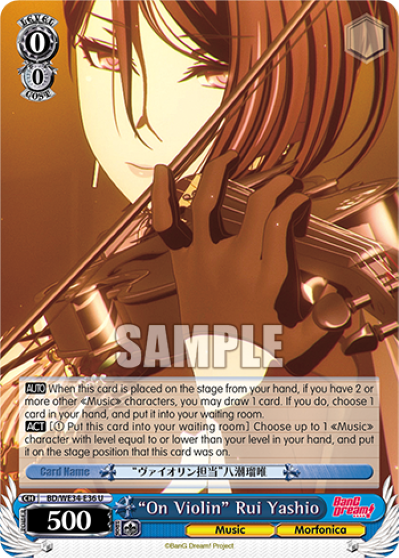
This serves a similar purpose as the Akane freeplayer that I currently have as a 2-of, so there’s an argument for a 1-1 split to allow for a finer adjustment of hand vs stock costs (and/or the option to do the draw/drop).

I feel like this deck tends to skew fairly strongly towards having hand and needing stock, though, so I’m inclined to stick with just the Akane. - MEMcho drop salvage:

This card is tempting since the deck already has a lot of level 2 or higher cards, but at least in the midgame, it tends to want to keep them on top of the deck. If I put in this card, it’d be replacing the riko, which is already nice in terms of giving a bit of top deck information.
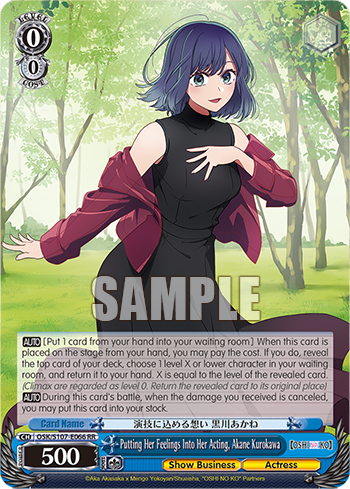
Still, there might be an argument for a 1-1 split; for one thing, that opens up the possibility of grabbing the drop salvage off the riko if you see a level 2 or higher on top and want the stock.
Level 2s and 3s:
- Aqua freefresh:

This is the card that most stood out to me as a benefit to this deck when I was looking at reveals. With both a 5-card brainstorm and a milling climax combo, it’s easy for the deck to get a bit too small for comfort; in that situation, freefreshing and then just comboing into the new deck seems like a very nice option to have. (There’s already the level 0 freefresh, of course, but that costs 1 to 2 more hand than this, depending on if you play over it or not — and since it’s 500 power, it’s pretty likely that you do.)

Even if you’re not in a position where you want to freefresh, you can also just spend 1 stock to convert the 2/1 Aqua into a draw; that might be good if you see a useful card on top of your deck with a riko or something. All that said, it’s probably just a 1-of; a lot of the time you’d prefer to attack into your current deck and get your climax into refresh, and with the level 0 freefresh as well (which is primarily there for the clock access), it’s not essential for it to be accessible. I think it’ll replace one of the bouncers; I don’t find myself wanting to use that too much (though of course it’s quite matchup dependent).

- Tsukuyomi healer:

Speaking of clock access, this Tsukuyomi could potentially provide that instead; it costs a lot more stock, though, on account of also healing and being a global 1k. I don’t think it really replaces the level 0 Aqua, in the end. - Ai level assist:

Giving a lane untargetable might be nice? Particularly if you’re playing multiple EPs. I feel like I’d generally prefer double brainstorm as the backrow, though. - Kana stockshuffle:

It would be nice to switch to the new stockshuffle, which takes less stock and doesn’t require a full field, but I don’t think it’s worth working in yellow to the deck.
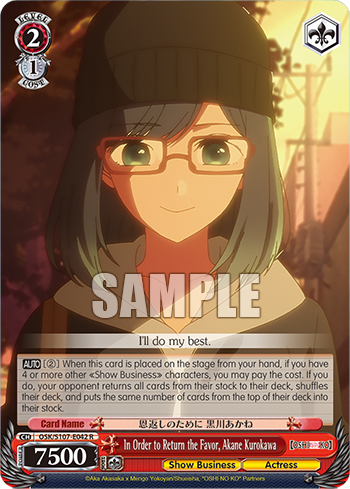
- Aqua burn 2:

This could replace the Kana restander (though honestly I’m not sure how useful that card is to begin with); it’s less susceptible to counterplay, and works in bad games where you don’t have a full field.

Still, the main use case for an alternative finishing option is when the opponent is uncompressed, and so I suspect the restander is better on account of doing more damage. It’s also red, which can be nice if you clock it at level 1 (or even level it, if it comes down to that). - Kana EP:

This is another card that seems like a significant benefit to the deck, though I’m not sure whether or not it’s better than my current EP healer.

It depends a lot on whether or not you have something that you want to sac anyway, I suppose, as well as on how easy or hard it is to get a reverse. This EP does have a worse EP condition, but the fact that the level 1 combo already wants to grab level 2 or higher characters means that it’s somewhat likely that you already have this in hand at level 2 rather than needing to brainstorm for it and potentially messing up the 2 or less condition (without reaching the 6 or more condition). It’s also nice that it doubles as an off-climax finisher (in particular, one that’s cheaper than the combo itself) or as an extender if you have extra resources on your finishing turn. At any rate, I’m already running 4 EP healers, so turning that into a 2-2 split seems like a pretty reasonable thing to do.
Putting that all together, here’s my first draft of updating this deck to set 3:

Deck Log: 26FBB
EncoreDecks: hsBrAguHl
(On a side note, it’s a bit disappointing that none of the cards I’m adding in here are from the actual anime, though to be fair neither were a lot of the cards they’re replacing. I’m also a bit worried that I’ll mix up the MEMcho drop salvage and the Akane freeplayer, on account of them both having solid purple backgrounds; at least they have different styles of sparkles, I suppose. This is something that bugs me about a lot of Weiß Schwarz cards, honestly, but I guess at the end of the day I mostly just care about the text rather than the artwork. And come to think of it, I kind of like the implication that Kana and Akane are celebrating Valentines Day together. It’s also kind of funny that both of the EPs show characters about to eat some sort of heart-shaped candy.)
Cats
Moving on to the other deck I had with set 2… well, this is really less of a cohesive deck and more just trying to find a shell that works with the level 1 Yuki and Akane package (which I call “cats” in reference to the similar Azur Lane package).
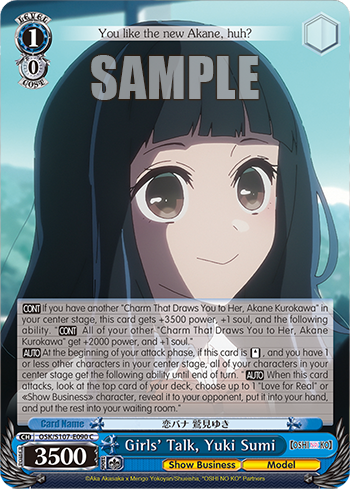



I went from 8 standby to 8 pants to most recently 8 empty door, but it always felt like mostly a meme, a soul-rush deck that loses steam quickly if the opponent doesn’t eat the big swings.
I’m not sure if this new set will change that, but it does at least have quite a promising package with the level 0 book combo.


The big issue I’ve run into with this deck is simply that there isn’t any room on the board. You ideally have 2 of each of the level 1s on board (with a Yuki in the back), giving you a 2-soul 7k and two 3-soul 9.5ks, which means that there’s only one other board slot, and so I often found myself playing over my brainstorm if I wanted to combo (which is part of why I ended up trying empty doors instead). The book combo itself doesn’t really fix that problem, but the event that it resonates with might: since it can grab itself back from the resolution zone, it gives you repeatable utility that doesn’t take up a board space. And while it’s not exactly a brainstorm, it at least fills some of the roles that a brainstorm does (milling and paying out stock, plus the same amount of selection as a check 3 brainstorm that hits 1), while also being a ditch outlet for any extra climaxes in hand (so long as they’re blue). Meanwhile, the combo itself provides a bit of selection (though not during the main phase), as well as just raw resources. This deck will probably still end up running lighter on resources than many others (particularly if the level 1s don’t survive), but it’ll hopefully at least be a bit better than before.
There’s actually another promising level 0 combo as well, on choice:

This one’s nice because it’s also a brainstorm, but I suspect the book combo is still better when you only have one board slot; the extra resources from the single combo probably make up for not being a brainstorm, plus it’s on-color and doesn’t require a reverse. This deck is hoping that the opponent will have to crash into its board, at least at level 1, and so not having a reverse target is a distinct possibility.
Since the event only serves as a ditch outlet for blue cards, I almost certainly want the finisher climax to be blue. There are 4 pants finishers: set 1 Akane, set 1 Aqua, set 2 Akane, and set 2 (level 2) Aqua. And there’s also a book finisher, set 3 Akane.
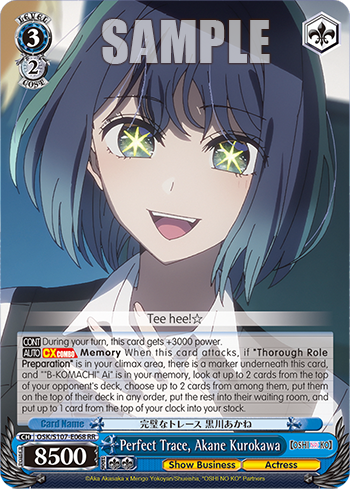
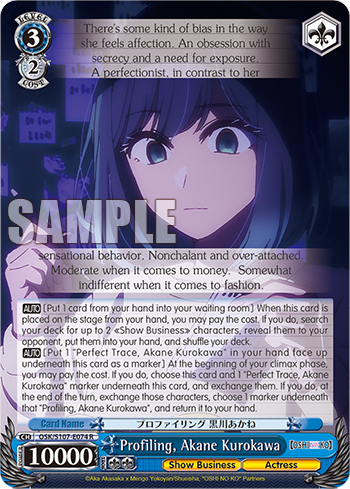
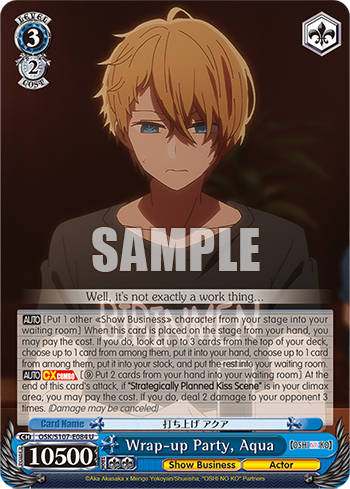


I’d been thinking I might try going for set 1 Aqua, to save deckspace, but even if this level 0 combo generates more resources than the previous one, I’m still worried about having enough to hit the threshold for that combo to do anything.
Set 1 Akane could be cool with the neg soul backup: you can potentially search out two and have the resources to play them; maybe even three, though the game would probably have to be going quite well. But it requires the Ai riki to be in memory, which doesn’t work well with this deck: you’re likely to play over it if the opponent sides it, and you don’t naturally have an Aqua or Ruby on stage to be able to play the event that can put it into memory. There’s also a 1/1 level assist that can put it in memory, so it’s at least workable, but it still takes up a lot of deckspace, which this deck is already spending on level 1s and events.

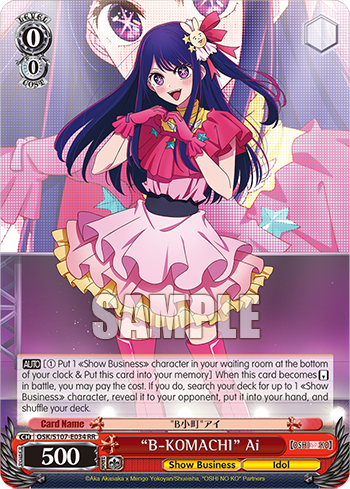


The level 2 Aqua is very cheap, but it’s also not much of a finisher. It presumably works best when you’re looking to play it down at level 2 and defend it, giving you multiple turns of the combo, but this deck is more likely to just continue with cats at level 2, while looping the level 0 combo. And while a single lane of the combo could be nice in the case where the opponent has a significantly more compressed deck than waiting room, there’s a card in the new set that can do that without a climax and in the main phase.

So that leaves set 2 Akane (which is what I played in the 8 pants version of the deck), and set 3 Akane. Set 2 Akane is cheaper, but most of that comes from the changer, which takes up deckspace, and I suspect that the set 3 Akane salvaging its own climax makes up for that in a lot of cases anyway: even though there is some ability to dig for the climax with the resonate-target event, that does cost stock, and might well require a climax swap in addition. Speaking of which, running the set 3 Akane probably means that a climax swap isn’t needed at all: if you slam the level 3 climax in the early- or mid-game, that’s probably about as good as climax swapping into the level 0 climax would have been anyway (particularly if you would have needed to sculpt into the climax swap to begin with). On the other hand, set 2 Akane can save you from needing to spend resources on decompression in some cases, and it heals. And its climax does have a better trigger (though in this deck, the soul trigger may well be a downside). I’m thinking I’ll give the set 3 Akane a shot to start with, but I might end up switching back to the set 2 Akane.
One other thing that the set 3 Akane grabbing its own climax does is open the possibility of running a third combo; in particular, I’m tempted to throw in the level 3 standby combo, despite the climax not being blue.

The idea here is that if you happen to have the standby in hand, and perhaps you lost some of the level 1s, you can use this instead of the level 0 combo; it doesn’t get you a stock, but it does help you win board. And it also works pretty well with the book finisher, giving it a bit of ability to control its topcheck burns.
Though putting the deck together a bit more, I’m thinking I might want the other color to be yellow rather than red. Part of that is just thinking that I’d prefer the new rize to the old fuka; besides the fact that it can grab level 0 characters (quite important if you’re still level 0), it also has a nice secondary ability.


Yellow also has a better 1/0 salvage event and stockshuffle than red.


Then again, maybe I don’t want to play either the fuka or the rize; I’m not sure if I can fit those alongside the level 0 combo setup pieces and still have room for a plussing 0. Though it looks like the best plussing 0 for this deck (which runs a significant number of events and benefits very little from level 0s staying on board) might be the on-death salvage riki, which is yellow anyway.

It’s nice that it’s a potential power pump and provides a bit of top deck information, as well.
OK, this was meant to be a relatively quick post, so let’s skip to the deck list:

Deck Log: 6CAUK
EncoreDecks: -X0jNtNAy
A couple thoughts, looking at the deck as a whole:
- This deck ended up with 19 level 1s; that’s pretty nice for the finisher, I think, making it fairly likely to burn 2.
- It also ended up with only 8 soul triggers, which is also pretty nice, making the cats less likely to completely overswing, and generally allowing for fairly predictable and controllable (with the book climaxes) damage numbers. (Though I guess the finisher goes back to being less predictable with its burns.)
And some notes about deckbuilding decisions that I didn’t already cover:
- I’m trying out only running 2 of each of the level 0 combo setup pieces (the combo itself, the resonate target, and the search bonder for the resonate target), since none of them are particularly good cards to see once you’ve got that initial setup done. Notably, once you have the event, there’s a level 0 Akane that can search out the combo if necessary, even on turn 1; that’s much more useful throughout the game, so I’m running that as a 3-of.


Of course, you still have to find the event in the first place. My hope is that 4 total cards is enough (2 events and 2 bonders), but it still feels a bit risky, since if both events come out into the waiting room, you’re out of luck until the next deck; at least the level 1s don’t rely on it. Running more events instead of bonders would minimize that fail case, but having at least one bonder is important to be able to riki for, and it’s also nice that it’s a playable attacker at level 0 (and just in general). - I’m only running three of the level 3 combo to save a bit of deckspace; my thought is that this deck likely doesn’t generate the resources for triple anyway (though of course it depends how the game goes), so I’d probably normally go for double plus the EP Kana (which can also serve as a healer if necessary).
- This deck is aiming to win board to some extent, and to that end it’s got a few backups. One nice thing about this combo is that it can grab them easily, and at encore step so you have a good idea of which one is most likely to be useful.


Alongside the fairly straightforward 1/1 backup that’s 4k when the opponent has a climax, this deck takes advantage of a couple backups that resonate with the same event as the combo and the finisher. The antichange is extremely cheap, but it doesn’t eliminate an attack (unless the opponent doesn’t have any level 0s in their waiting room), so it’s only useful for winning board or generally removing annoying characters. (It’s also the only costless backup in the set.) There’s an argument for running the level 2 antichange backup as well, but to some extent the anti-damage role is covered by the third backup, the neg soul. Minus 2 soul certainly isn’t the most powerful defensive counter around (and the opponent likely has the option to side a level 1 instead), but it’s at least easy to threaten if you expect your opponent to be going for a finish; or if you have extra resources, it can be a good way to use those. - I put in a 1-of brainstormer since there may well be situations where it’s useful even if you play over it (like a small compressed deck, where you don’t really want to trigger and draw all those books), or where you end up with room in the back row for it.

I don’t think of it as part of the main gameplan of the deck, though; the ideal board is probably still 2 vanillas, 2 Yukis, and the level 0 combo. Maybe one or both of the backrows gets pushed up at level 2, and it’s worth it to play the brainstorm at that point; that likely doesn’t leave too many turns to get use out of the brainstormer, but it is at least somewhat useful on the finishing turn, with the topcheck(s).
MEMcho Topend
Another deck I wanted to try to make is one with the new MEMcho topend with antiburn, combined with the neg soul event from the first set.


Ideally you get triple combo followed by the event, letting you heal 3 times and potentially not even leave the opponent with enough damage to threaten lethal at all. Of course, there are plenty of ways for the opponent to dodge one or both of these defensive effects; in some matchups they’re basically useless, and in others it just means that the opponent has to put a bit more effort into their finishing turn (though you can still hope that that makes it a bit less potent than it would otherwise be). So the effectiveness of this deck will likely depend significantly on the meta, but it’s something I want to try out regardless.
The full triple combo plus event is 6 stock and 9 hand, though that leaves you with 1 stock and 0 hand going into the next turn, and the combo is small on defense, so you probably want a bit more resources than that.
For the advantage engine, my thought is that the new level 0 MEMcho combo is the way to go.
Being on choice lets you use the free choice climax swap, and being a check 4 brainstorm helps find the event. This of course means that the deck is 8 choice; and while this is pretty different from the set 1 deck, I do think I want to include the level 2 MEMcho combo (this has ended up as a MEMcho deck in general, it seems).


Besides the potential to generate a lot of resources, the level 2 combo also provides a board to hopefully give you an opportunity to use the event if the opponent hits level 3 first (or can help fill out the board if you only get double level 3 combo, for example).
So here’s my first draft of this deck:

Deck Log: 28PV1
EncoreDecks: Xyukd6dTO
And some deckbuilding notes:
- 4/3/1 climax split: This is enabled by the combination of the 3/0 event, the free climax swap, the clockswap (plus the fact that the combo heals), and the fact that the combo doesn’t need any stock going into the attack phase.

That all means that there’s nowhere the climax can be where it’s not accessible, and likely fairly easily so (outside of the opponent sending it to memory, or some ridiculous situation where you levelled it, I suppose). However, the fact that you want a lot of hand (unlike the Kana combo that the 8 choice build in set 1 ran) might mean that you’d prefer not to have to use the climax swap, so I could see 4-2-2 being better for this deck. The brainstorm does make it relatively easy to refresh, though, so that may well be an option to avoid needing to climax swap, letting you just search out the climax directly. The other consideration here is whether or not you’re likely to want to play the climax again the next turn (since a large part of the goal here is to survive), but with the finisher being fairly small on the opponent’s turn, I don’t think that’s too likely anyway, and so at least to start with, I’m focusing instead on making it as easy as possible to get (and potentially loop) the level 2 climax. The followup turn after surviving at level 3 will most likely just be vanilla swings with maybe a burn 1 from the Kana EP; the hope is that the level 3 combo turn already did enough damage for that to be able to finish the job.
- My thought is that the combination of the riko and the level 1 Kana can dig towards a climax for the brainstorm (or a level 1+ for the Ruby level 1), while also getting a filter.


If the riko reveals a 1 or higher character, it can grab the Kana directly, though I’d prefer to already have the Kana in hand in case it reveals a level 0 character. There’s a good chance that the Ruby is the higher priority sculpt regardless, though. - The Kana rize is a 1-of as a tech option against runners; similarly, the Meiya is an option to get around walls (or perhaps a JC in the back).

Though if you can’t get reverses, you could also just rely more on the level 2 combo I suppose, leaning into brainstorms or rikis to make it to that point, with the level 1 Ruby to potentially recoup stock. - I went for the salvage riki as my plussing 0 because it can let you attack with the brainstormer and then salvage it back; with a level 0 combo but not a lot of room for level 0s, it’s fairly likely that this deck will want to attack with the brainstorm if it’s comboing at level 0.
The cleancut and JC can also enable that, but they both swing small (particularly bad for the cleancut, on top of this deck already having a climax swap), and the salvage riki has the option to grab something that wasn’t on stage as well (perhaps something that was in the level 0 clock before levelling up). The salvage riki is also a power pump (most of the time) and provides a bit of top check information.


(I previously used the term “Shinobu” instead of “JC” in these articles, but I feel like the term “JC” remains much more recognizable, so I’m just going to go with that. Apparently the etymology of that is somewhat problematic — a term used by lolicons to refer to middle school girls — but I suspect a lot of people aren’t even aware of that association. Also, at one point I saw someone say they thought it stood for “Jesus Christ” because the character sacrifices themself to save someone else, so I figure we can just go with that.)
For the deck name, I just based it on the level 3 MEMcho’s card name. Apparently “バーンして!” is an idol concert thing requesting for fans to make finger guns, so バーン (baan) presumably means “bang” there. But the same word can also mean “burn”, and I believe that’s used as a jargon for damage in Japanese in the same way it is in English. Of course, the funny thing about that is that MEMcho prevents burns; one might say she bans them. And so putting those together, we get the name of the deck: “Bang! Burn Ban”, which concisely describes what the combo does.

Leave a Reply